Task-Specific Functional Training vs. Traditional Strength Training: How the Body Truly Adapts
When people talk about strength training, they often imagine barbells, dumbbells, and classic gym lifts. Others think of “functional” training—step-ups, carries, balance work, mobility drills, and exercises that mimic everyday tasks.
Most people treat these as two different worlds. But they aren’t competing ideas. They are two parts of the same biological system.
To understand why, you have to look at how the body actually adapts—at the neuromuscular, biomechanical, and functional level.
This article breaks down the science behind each approach, why older adults benefit from both, and how combining them prevents late-life disability and functional decline.

What Traditional Strength Training Actually Builds
Traditional resistance training (squats, presses, deadlifts, rows) is extremely well-researched. It creates predictable physiological adaptations:
1. Increased Maximal Force Production (Strength)
Muscle fibers grow (hypertrophy), and the nervous system becomes better at recruiting motor units efficiently and in larger quantities.
2. Improved Rate of Force Development
Your ability to produce force quickly increases—critical for catching yourself, reacting to a misstep, or stabilizing during unexpected movement.
3. Stronger Tendons, Ligaments, and Bones
Resistance training is one of the most effective ways to prevent osteoporosis and maintain skeletal integrity.
4. Joint-Specific Strength
By moving through controlled ranges of motion under load, joints become stable and resilient.
5. Cardiometabolic Improvements
Strength training improves insulin sensitivity, cardiovascular efficiency, and resting metabolic rate—even without “cardio.”
Traditional strength training builds your physical capacity.
But here’s the catch:
Having strength doesn’t guarantee you can use it in complex, real-world situations.
And that’s where functional training fills the gap.
What Task-Specific Functional Training Builds
Functional training focuses on movements, not muscles.
Instead of isolating a joint or single muscle group, functional training teaches your body to work as a system—just like it must in real life.
1. Task-Specific Coordination
Your brain learns the exact motor patterns you need for tasks like standing up, climbing stairs, or stepping sideways over obstacles.
2. Intermuscular Communication
Multiple muscles learn to fire together with the right timing, sequence, and intensity.
3. Balance and Stability in Unpredictable Environments
Real life is not symmetrical. Functional training prepares you to stabilize on uneven surfaces, narrow steps, or shifting loads.
4. Improved Gait and Movement Efficiency
Because the nervous system adapts to the pattern, people move with less energy cost and less risk of compensations.
5. Daily-Life Strength (Not Just Gym Strength)
You become stronger at the tasks you actually do—getting off the floor, carrying groceries, climbing stairs, lifting grandkids, etc.
Functional training builds your ability to apply strength.
Why Task Specificity Matters More With Age
As we get older, strength still matters—but usable strength matters more.
Most late-life disability doesn’t begin with a major medical event. It begins when daily tasks become too challenging to perform safely or consistently.
Examples:
Using 100% of your strength just to climb one set of stairs
Struggling with sit-to-stand transitions
Feeling unstable during single-leg tasks
Avoiding bending, reaching, or carrying
Losing confidence in movement
When a task becomes difficult, people avoid it. Avoidance causes weakness. Weakness reduces confidence. Reduced confidence leads to inactivity.
And inactivity accelerates decline.
Task-specific functional training interrupts this cycle.
It helps people keep performing the tasks that preserve independence.
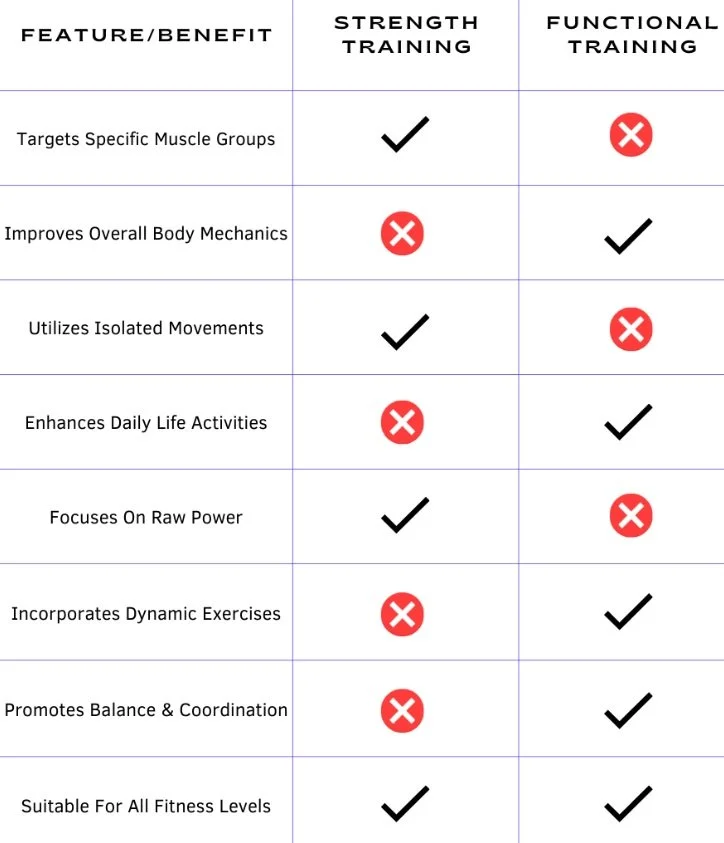
So Which Is Better? Strength Training or Functional Training?
The answer is clear:
You need both.
Traditional strength training gives your body the horsepower.
Functional training teaches your body how to drive the car.
If you only lift weights, you may become strong but uncoordinated in real-life tasks.
If you only do functional exercises, you may become coordinated but lack sufficient strength to actually use those patterns under load.
The most effective training programs—especially for adults over 40—use a hybrid approach:
Foundational Strength Work
Squats
Deadlifts
Presses
Rows
Carries
Task-Specific Functional Work
Sit-to-stand variations
Step-ups and stair-climbing drills
Lateral movements
Single-leg balance and strength
Floor transfer training
Rotational stability work
This combination not only improves gym performance—it extends independence, prevents disability, and slows degenerative decline.
Practical Example: Step-Ups vs. Squats
Here’s a simple breakdown:
The squat increases knee and hip strength, builds muscle mass, strengthens tendons, and boosts bone density.
The step-up improves the exact neuromuscular pattern used to climb stairs—balance, weight shifting, knee control, ankle stability, and unilateral force production.
A person who trains both can climb stairs with confidence and power.
A person who trains only one will have gaps.
This is the essence of specificity.
Practical Example: Sit-to-Stand Training
Traditional strength training might include:
Goblet squats
Leg press
Box squats
Functional training includes:
Task-specific sit-to-stand drills
Low-chair progressions
Controlled descents
Uneven or offset loading
Mimicking real-life chair heights
Aging adults don’t lose the ability to squat—they lose the ability to get out of chairs.
This is why both approaches matter.
The Ideal Program for Aging Well
A balanced program includes:
1. Strength Training Twice Per Week
5–6 foundational lifts
Low to moderate load
Slow progression
Focus on full-body strength
2. Functional Training 2–3 Times Per Week
Movement-quality drills
Balance and stability work
Task-specific training
Mobility and gait improvements
3. Daily Low-Intensity Movement
Walking
Stairs
Household activity
Light mobility
This combination supports long-term health, independence, and functional capability better than any single method on its own.
Final Thoughts
Strength gives you the capacity to move.
Functional training gives you the ability to move.
Aging adults deserve both.
When these two forms of training work together, the result is not only more strength—it’s more stability, confidence, mobility, safety, and independence. This combination is one of the most powerful tools we have to prevent late-life disability and maintain quality of life.